Introduction
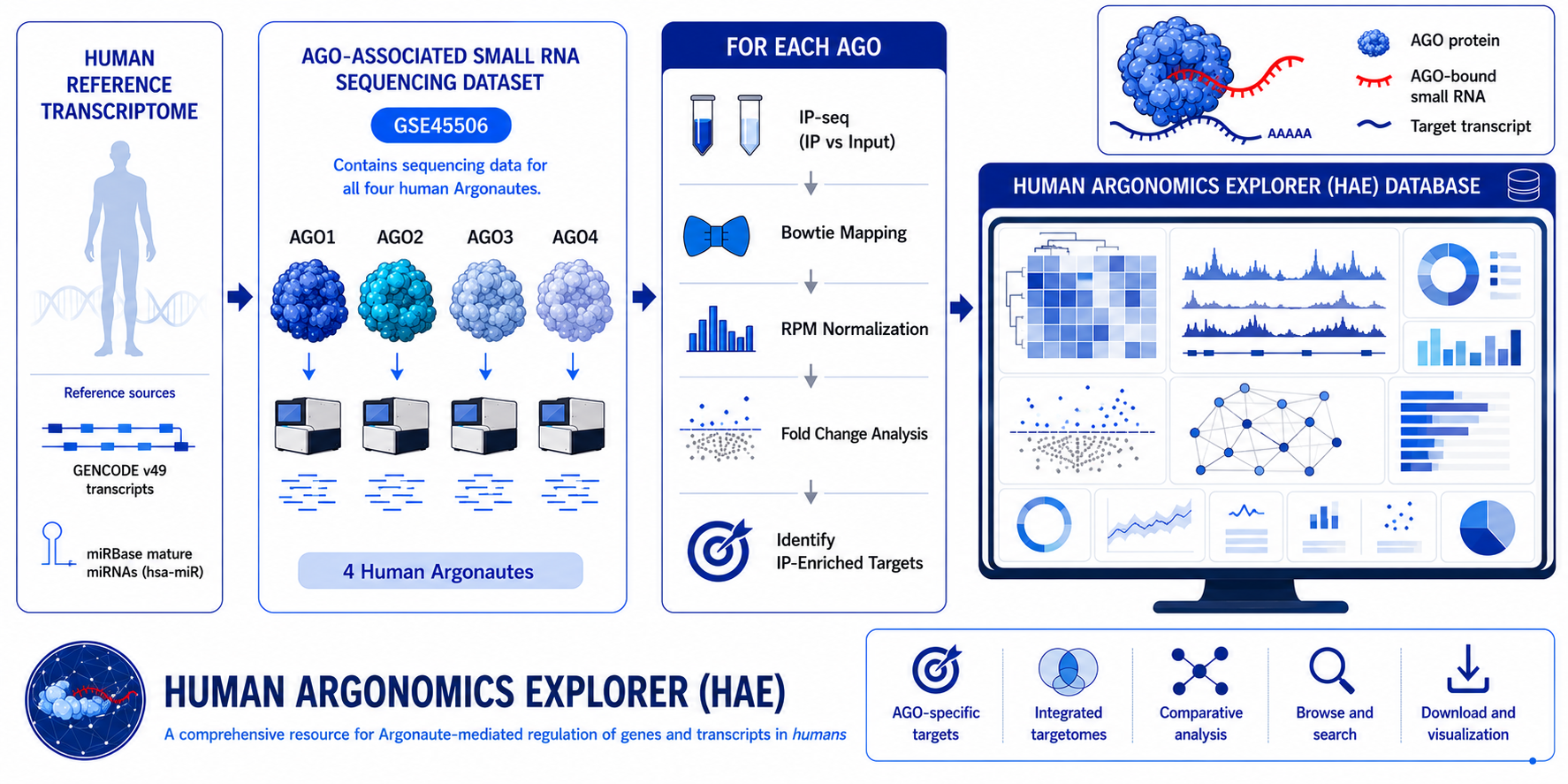
The Human Argonomics Explorer (HAE) is an interactive resource for investigating small RNAs associated with the four human Argonaute proteins, AGO1, AGO2, AGO3, and AGO4. Human Argonautes are central components of the RNA-induced silencing complex: they bind small RNAs and use sequence complementarity to recognize RNA targets.
HAE organizes Argonaute immunoprecipitation (IP) sequencing data at the RNA level. Sense-mapped reads help identify small RNAs carried by each AGO, whereas anti-sense-mapped reads provide candidate RNA targets with complementary AGO-associated small RNAs. The database therefore supports exploration from either a small RNA or a target-transcript perspective.
Background
HAE uses the public small RNA sequencing series GSE45506. In this study, endogenous AGO1, AGO2, AGO3, and AGO4 were immunoprecipitated separately from human HeLa cells, and the associated small RNAs were sequenced together with an input sample. This experimental design enables direct comparison of RNA abundance in each AGO IP against the common input background.
The original study examined how human miRNAs associate with different Argonaute proteins and highlighted the specialized role of AGO2 in miR-451 processing. HAE extends the utility of these data by mapping AGO-associated reads to an annotated human RNA reference and presenting the results through searchable, strand-aware evidence.
Motivation
Public AGO-IP datasets are valuable for studying small-RNA loading, but raw read files and sample-level tables are not convenient for transcript-centered exploration. It is difficult to start with one human miRNA, gene, or transcript and quickly compare its AGO1–AGO4 enrichment, strand, supporting values, and positional coverage.
HAE addresses this need by combining human RNA annotations with normalized AGO-IP evidence in a single web interface. Users can search an RNA directly or construct AGO-associated RNA sets without processing the raw sequencing data themselves.
Contributions
- 🔸 Reanalyzed public human AGO1–AGO4 IP small RNA sequencing data at RNA level
- 🔸 Distinguished sense AGO-associated RNAs from anti-sense candidate target RNAs
- 🔸 Integrated miRBase, Ensembl, HGNC, and NCBI identifiers for flexible searching
- 🔸 Provided enrichment evidence, positional mapping details, filtering, and set operations
Search Page
The Search page supports two complementary questions. Select a mode, enter an identifier, choose an autocomplete result, and click Search.
| Search mode | Purpose | Example |
|---|---|---|
| Small RNA of interest | Identify AGO1–AGO4 proteins associated with the RNA using sense-mapped IP enrichment. | miR-99b-5p or MIMAT0000132 |
| Transcript of interest | Identify AGO-associated small RNAs mapping anti-sense to a candidate target transcript. | ZNF860 |
Queries may use supported identifiers such as:
- miRBase name or MIMAT accession
- HGNC ID, human gene symbol, or NCBI Gene ID
- Ensembl gene ID or Ensembl transcript ID
- RNA sequence ID or transcript name
Reading the results
- Gene information summarizes the matched gene, external identifiers, and isoform count.
- Argonaute IP enrichment lists the matched RNAs and shows which of AGO1–AGO4 pass the target criteria. Use the Sense/Anti-sense toggle to change the mapping orientation.
- Evidence opens the IP RPM, input RPM, and enrichment values supporting the selected RNA.
- Details displays positional read coverage for selected AGO IP and input tracks.
Browse Page
The Browse page retrieves complete RNA lists associated with selected Argonautes. Choose one or more AGO1–AGO4 datasets in either orientation and click Submit.
| Dataset type | Interpretation |
|---|---|
| IP Enriched (S) | RNAs represented by sense-mapped reads and enriched in the selected AGO IP. |
| IP Enriched (AS) | RNAs represented by anti-sense-mapped reads, indicating candidate targets of AGO-associated small RNAs. |
When two previously generated lists are selected, HAE can calculate their intersection, union, or directional difference. Browse history records each generated list and its RNA count. The result table provides RNA annotations, AGO-specific IP values, links to evidence and mapping details, and export options for downstream analysis.
Reference Transcriptome
HAE uses an integrated Homo sapiens RNA reference so that both AGO-associated small RNAs and their possible complementary targets can be queried in one system. Reference records retain cross-database identifiers whenever available, enabling a query entered with a miRNA accession, gene symbol, or transcript ID to resolve to the same underlying RNA record.
| Reference component | Representative annotations | Use in HAE |
|---|---|---|
| Protein-coding transcripts | Ensembl transcript/gene IDs, gene symbol, HGNC and NCBI Gene IDs | Candidate target-RNA search and anti-sense mapping |
| Long and other non-coding RNAs | Transcript name, gene type, sequence ID | AGO association and candidate target exploration |
| Mature miRNAs | miRBase name, MIMAT accession, and miRNA arm | Small-RNA search and AGO loading comparison |
| Gene-level annotations | Description, chromosome, synonyms, orientation, and protein accessions | Search resolution and biological interpretation |
Data Analysis
Small RNA reads from the AGO1, AGO2, AGO3, and AGO4 IP libraries and the corresponding input library were processed to remove library adapters and low-quality sequence. The retained reads were aligned to the human RNA reference, and sense and anti-sense alignments were recorded separately for each RNA.
Mapped read counts were normalized as Reads Per Million (RPM). For every RNA, AGO, and orientation, enrichment was calculated by comparing the AGO IP abundance with the input abundance. An RNA is labeled IP Enriched when both criteria are met:
- IP RPM ≥ 5
- IP enrichment ≥ 2 relative to input
HAE stores the underlying IP, input, enrichment, strand, and positional coverage values. Passing the threshold is a reproducible indicator of AGO association in this dataset; it should be interpreted as candidate evidence rather than proof of direct functional regulation.
GSE45506
Source: GSE45506 — miRNAs associated with the different human Argonaute proteins
The HAE analysis uses endogenous AGO1–AGO4 IP and input small RNA sequencing libraries from human HeLa cells.
| GSM ID | Description |
|---|