Introduction
The Fly Argonomics Explorer (FAE) is an interactive resource for studying Argonaute-associated RNAs in Drosophila melanogaster. The fly small-RNA system contains two major Argonaute pathways: AGO1 is preferentially associated with miRNAs, whereas AGO2 is preferentially associated with siRNAs and can also carry a subset of miRNAs.
FAE organizes AGO1 and AGO2 immunoprecipitation (IP) small RNA sequencing evidence from wild-type and pathway perturbation conditions. Sense-mapped reads reveal RNAs carried by an AGO complex, while anti-sense-mapped reads identify candidate transcripts complementary to AGO-associated small RNAs.
Background
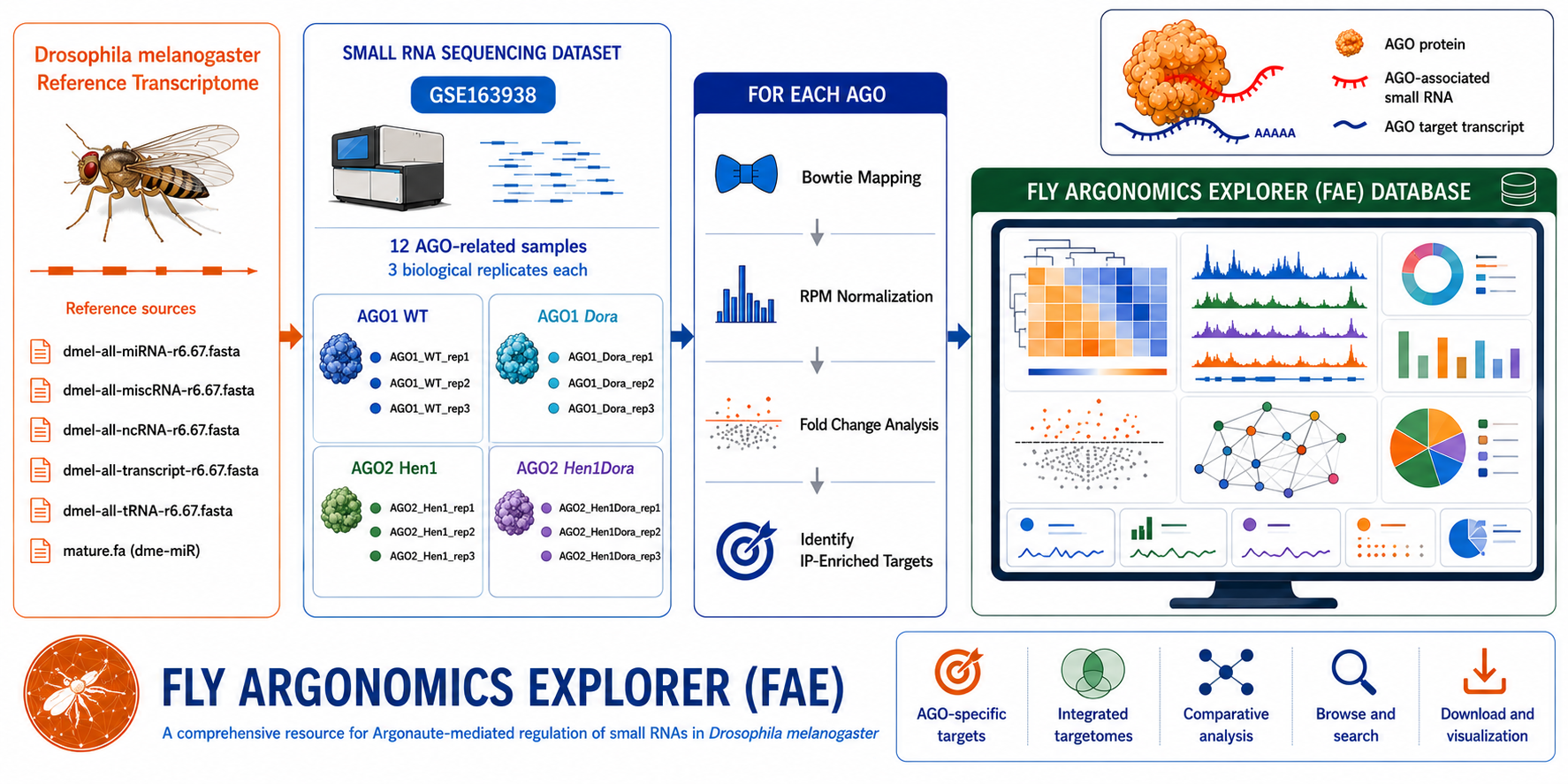
FAE uses the public small RNA sequencing series GSE163938, generated from Drosophila S2 cells to investigate target-directed degradation of small RNAs. The study compared wild-type cells with cells lacking Dora, a factor required for target-directed miRNA degradation, and cells lacking the small-RNA methyltransferase Hen1 with or without Dora.
AGO1-associated small RNAs were profiled in WT and Dora conditions. AGO2-associated small RNAs were profiled in Hen1 and Hen1Dora conditions, allowing the effects of AGO identity, 3′-terminal methylation, and the Dora pathway to be examined. Each condition contains three biological replicates and is paired with a corresponding total small RNA library used as input in the FAE enrichment analysis.
Motivation
The source study was designed to answer mechanistic questions about small-RNA stability. Reusing its sequencing data for a specific fly miRNA, gene, or transcript still requires users to reconcile many sample names, replicates, strands, IP/input values, and annotation systems.
FAE converts these data into an RNA-centered resource. It makes condition- and replicate-specific AGO evidence searchable and supports comparisons between AGO1, AGO2, WT, Dora, Hen1, and Hen1Dora without requiring users to process the raw sequencing libraries.
Contributions
- 🔸 Reanalyzed AGO1 and AGO2 IP small RNA data from Drosophila S2 cells
- 🔸 Preserved condition and replicate information across WT, Dora, Hen1, and Hen1Dora samples
- 🔸 Distinguished sense AGO-associated RNAs from anti-sense candidate target RNAs
- 🔸 Integrated FlyBase, miRBase, and NCBI annotations with evidence and coverage views
- 🔸 Enabled filtering and set operations across condition-specific AGO RNA lists
Search Page
The Search page supports two complementary questions. Select a mode, enter an identifier, choose an autocomplete result, and click Search.
| Search mode | Purpose | Example |
|---|---|---|
| Small RNA of interest | Identify AGO1/AGO2 samples associated with the RNA using sense-mapped IP enrichment. | miR-317-3p or MIMAT0000409 |
| Transcript of interest | Identify AGO-associated small RNAs mapping anti-sense to a candidate target transcript. | mtgo |
Queries may use supported identifiers such as:
- miRBase name or MIMAT accession
- FlyBase gene ID or FlyBase transcript ID
- Fly gene symbol, transcript name, or NCBI Gene ID
- RNA sequence ID or miRNA arm
Reading the results
- Gene information summarizes the matched fly gene, FlyBase and NCBI identifiers, and isoform count.
- Argonaute IP enrichment reports condition- and replicate-specific AGO1/AGO2 associations. Use the Sense/Anti-sense toggle to change the mapping orientation.
- Evidence opens the IP RPM, input RPM, and enrichment values supporting the selected RNA.
- Details displays positional read coverage for selected AGO IP and input tracks.
Browse Page
The Browse page retrieves complete AGO-associated RNA or candidate target-RNA lists. FAE provides datasets for four experimental groups, each with three replicates and separate sense/anti-sense results.
| Group | Replicates | Biological context |
|---|---|---|
| AGO1_WT | rep1–rep3 | AGO1-associated RNAs in wild-type S2 cells |
| AGO1_Dora | rep1–rep3 | AGO1-associated RNAs in Dora-deficient S2 cells |
| AGO2_Hen1 | rep1–rep3 | AGO2-associated RNAs in Hen1-deficient S2 cells |
| AGO2_Hen1Dora | rep1–rep3 | AGO2-associated RNAs in Hen1/Dora double-deficient S2 cells |
Use IP Enriched (S) to retrieve RNAs carried by an AGO complex and IP Enriched (AS) to retrieve candidate complementary target RNAs. Multiple lists can be combined using intersection, union, or directional difference. Browse history records generated sets and RNA counts, while the result table provides annotations, sample-specific IP values, evidence/detail links, filters, and export options.
Reference Transcriptome
FAE uses an integrated Drosophila melanogaster RNA reference assembled from fly transcript and small-RNA annotations. Cross-references connect sequence records to FlyBase, miRBase, and NCBI identifiers so that users can move between mature miRNAs, transcript isoforms, and their parent genes.
| Reference component | Representative annotations | Use in FAE |
|---|---|---|
| Protein-coding transcripts | FlyBase gene/transcript IDs, transcript name, and gene type | Candidate target-RNA search and anti-sense mapping |
| Long and other non-coding RNAs | FlyBase type, parent ID, location, and database cross-references | AGO association and candidate target exploration |
| Mature miRNAs | miRBase name, MIMAT accession, miRNA precursor, and arm | Small-RNA search and AGO loading comparison |
| Gene-level annotations | NCBI Gene ID, symbol, description, chromosome, synonyms, and orientation | Search resolution and biological interpretation |
Data Analysis
Small RNA reads from 12 AGO IP libraries and their matched total small RNA inputs were processed to remove library adapters and low-quality sequence. The retained reads were aligned to the fly RNA reference, with sense and anti-sense alignments quantified separately for every experimental condition and biological replicate.
Mapped read counts were normalized as Reads Per Million (RPM). For every RNA, AGO sample, and orientation, enrichment was calculated by comparing the AGO IP abundance with the matched input abundance. An RNA is labeled IP Enriched when both criteria are met:
- IP RPM ≥ 5
- IP enrichment ≥ 2 relative to the matched input
FAE retains replicate-level IP, input, enrichment, strand, and positional coverage values rather than merging the four biological conditions. A passing result is evidence of AGO association in that sample and should be interpreted as a candidate relationship, not by itself as proof of direct functional regulation.
GSE163938
The FAE analysis uses 12 AGO IP libraries and 12 corresponding total small RNA libraries from Drosophila S2 cells. Each WT, Dora, Hen1, or Hen1Dora condition contains three biological replicates.
| GSM ID | Description |
|---|